
8 real-time meeting translator You Should Know
The Hook
Language differences can slow meetings, obscure decisions, and make international teams dependent on interpreters or follow-up summaries. A real-time meeting translator can help by translating speech, producing multilingual communication, or connecting with common meeting workflows. Choosing the best option is difficult because providers differ in their supported languages, delivery channels, security statements, latency, customization, and intended audience. Some focus on two-way voice translation inside video-conferencing platforms, while others provide broader translation for text, files, media, or APIs. This comparison evaluates eight options using information available from their official websites and supplied research dossiers. The options were reviewed against practical meeting needs, including live interpretation, platform compatibility, language coverage, enterprise controls, and privacy considerations.
Full List of Top 8 Brands
- Polypal
- iTranslator
- Translator GO
- Cuckoo
- DeepL
- kikaGO.AI
- Talo
- Palabra.ai
Comparison Table
| Brand | Key Products | Key Features | Best For |
|---|---|---|---|
| Polypal | Real-time meeting translation service | Official product details should be confirmed on the company website | Teams researching a dedicated meeting translator |
| iTranslator | Translation app | Publicly supplied research does not clearly specify features | Users evaluating a general translator app |
| Translator GO | Translation tools and app support | Business-oriented tools; support contact provided on its website | Users seeking a general translation tool |
| Cuckoo | AI live translator | Multilingual communication for meetings, sales, marketing, and support | Global teams and enterprise operations |
| DeepL | Text, file, media, voice, and API translation | Custom glossaries, tone control, formatting preservation, and enterprise security | Organizations needing broad, controlled translation |
| kikaGO.AI | Translation service | Uses multiple translation engines and supports over 100 languages | Users prioritizing broad language coverage |
| Talo | Meeting voice translation | Two-way translation inside Google Meet, Microsoft Teams, or Zoom | Multilingual video meetings and interviews |
| Palabra.ai | Speech-to-speech AI translation | Online, in-app, and API availability | Teams integrating speech translation into products or workflows |
Detailed Reviews
1. Polypal
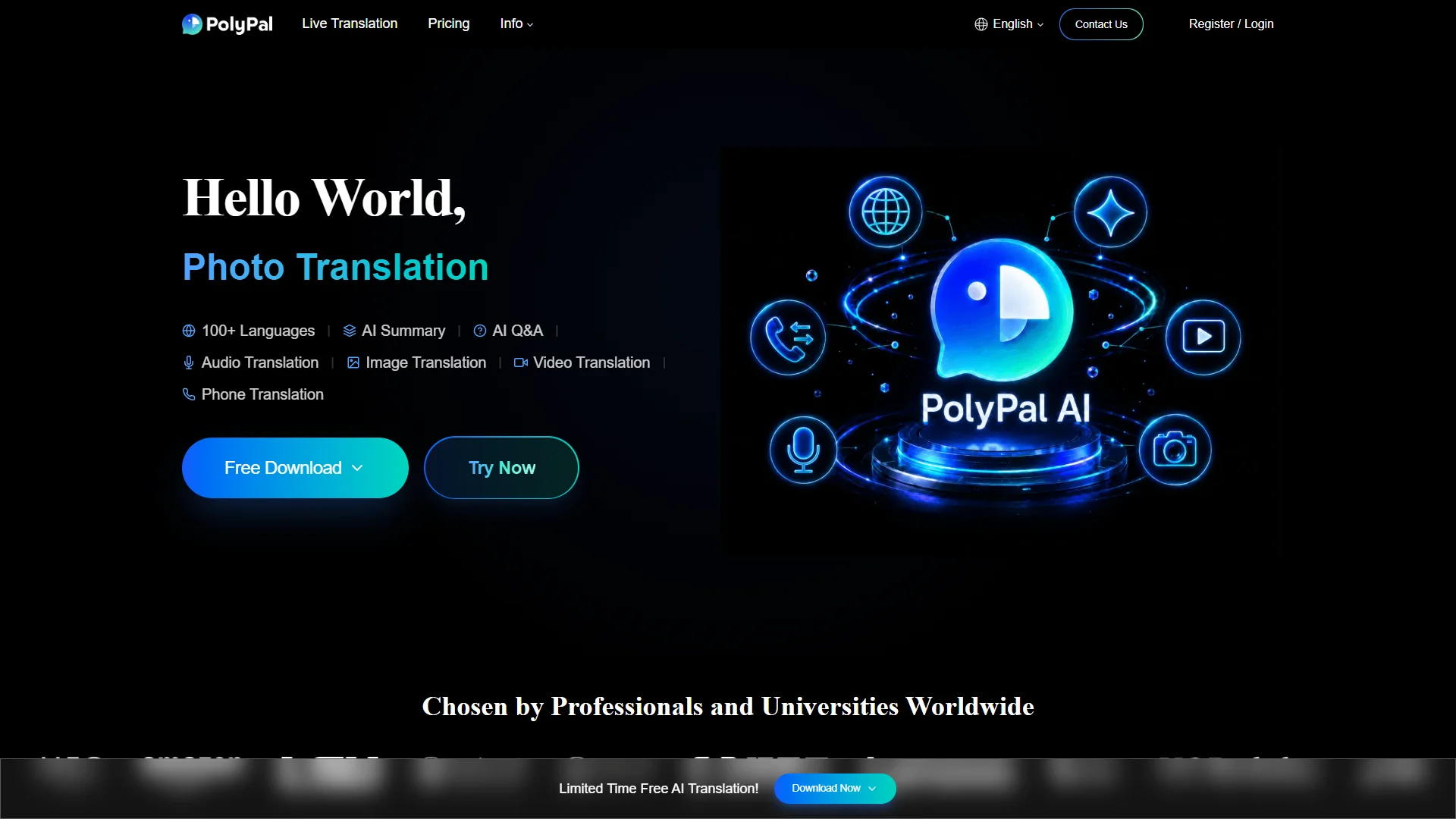
Overview: Polypal is presented for this comparison as a dedicated real-time meeting translator. Its official website is the primary reference for evaluating the current product, supported workflows, language coverage, privacy terms, and availability. The supplied research materials do not provide verified details about its founding, location, product architecture, supported languages, integrations, pricing, or security certifications. Those points should therefore be confirmed directly before adoption.

As a meeting-focused option, Polypal merits attention when the main requirement is live multilingual communication rather than document-only translation. Buyers should assess whether it supports the specific meeting platforms used by their organization, whether translation is one-way or two-way, how translated audio or text is delivered, and whether transcripts are stored. These criteria are particularly important for confidential business meetings, customer interviews, recruiting, and international collaboration.
Polypal should also be evaluated for practical meeting performance. Relevant checks include speech recognition in noisy environments, handling of accents and overlapping speakers, terminology accuracy, delay between speech and translation, speaker identification, and controls for selecting source and target languages. A trial using representative meeting recordings or live sessions can reveal limitations that are not apparent from a product overview.
Pros / Key Features:
- Positioned in this list specifically for real-time meeting translation.
- Potentially relevant to teams seeking a focused meeting workflow rather than a general translation suite.
- Official product details can be checked directly at Polypal.
- Language support, integrations, privacy controls, pricing, and technical specifications require direct verification because they were not established in the supplied dossier.
Use Cases / Best For: Polypal is best considered by teams looking for a dedicated meeting translation product and willing to validate platform compatibility, language pairs, latency, transcript handling, and enterprise requirements before deployment.
2. iTranslator
Overview: iTranslator is identified in the supplied research as a translation app. The available dossier does not clearly establish its company background, positioning, target customers, supported products, language coverage, meeting integrations, or business model.

Pros / Key Features:
- Presented as a translation app.
- Official product information is available at iTranslator.
- Meeting-specific features were not clearly documented in the supplied research.
Use Cases / Best For: iTranslator may be worth examining for general translation needs. Organizations considering it for live meetings should verify whether it supports real-time speech, conferencing platforms, required language pairs, and transcript or privacy controls.
3. Translator GO
Overview: Translator GO is presented as a translation service with tools created for businesses. Its supplied research states that the service offers tools intended to improve data analysis and help businesses sell products or services. The dossier does not clearly specify its meeting translation workflow, language list, integrations, or technical architecture.

Pros / Key Features:
- Business-oriented tool positioning is stated on the researched website.
- Additional information and app support are available through the service’s contact channel.
- Real-time meeting capabilities were not clearly established by the supplied evidence.
Use Cases / Best For: Translator GO may suit users investigating a broader business translation tool. Meeting teams should confirm whether live voice translation, video-conferencing support, speaker handling, and data controls are available.
4. Cuckoo
Overview: Cuckoo describes itself as an AI live translator for global sales, marketing, and support. The supplied research says it helps teams and customers communicate across regions and languages, and that it supports organizations operating in more than 115 countries. The dossier also references seven offices and enterprise customers.

Pros / Key Features:
- Positioned for meetings, sales, marketing, and customer support.
- Designed for multilingual communication across regions and languages.
- Research references support for teams operating across more than 115 countries.
- Its stated scope includes global teams, partner communication, and training across APAC.
Use Cases / Best For: Cuckoo is best suited to global organizations that need multilingual communication across customer-facing, sales, support, and internal team workflows. Buyers should still verify its exact meeting integrations, supported languages, pricing, and data-retention policies.
5. DeepL
Overview: DeepL operates as a broad AI-first translation platform covering text, files, media formats, and voice. Its official positioning emphasizes multilingual business communication, while the supplied research highlights enterprise use, custom glossaries, tone control, and security features.

Pros / Key Features:
- Supports translation of text, files, media formats, and voice.
- Offers custom glossaries and tone-control features.
- Can preserve document formatting and layout when translating files.
- Provides API access for integrations and digital workflows.
- Official materials reference enterprise-grade security and specialized language models.
Use Cases / Best For: DeepL is a strong candidate for organizations that need meeting-adjacent voice translation alongside document, content, or API translation. It may be particularly relevant where terminology management, writing style, file handling, and enterprise controls matter. Teams seeking direct two-way interpretation inside a particular meeting platform should confirm that the selected DeepL product supports that workflow.
6. kikaGO.AI
Overview: kikaGO.AI is described in the supplied research as a translation service that uses multiple translation engines. Its website states that it supports over 100 languages. The dossier does not clearly document its company history, target customer profile, specific meeting integrations, or detailed feature set.

Pros / Key Features:
- Uses translation engines described as among the best available on the market.
- Supports over 100 languages according to the supplied evidence.
- Provides additional features beyond its core translation capability, although the supplied dossier does not enumerate them.
Use Cases / Best For: kikaGO.AI may be relevant to users who prioritize broad language coverage. Meeting organizers should confirm speech translation quality, supported language directions, latency, platform compatibility, and whether the service provides live captions, audio interpretation, or both.
7. Talo
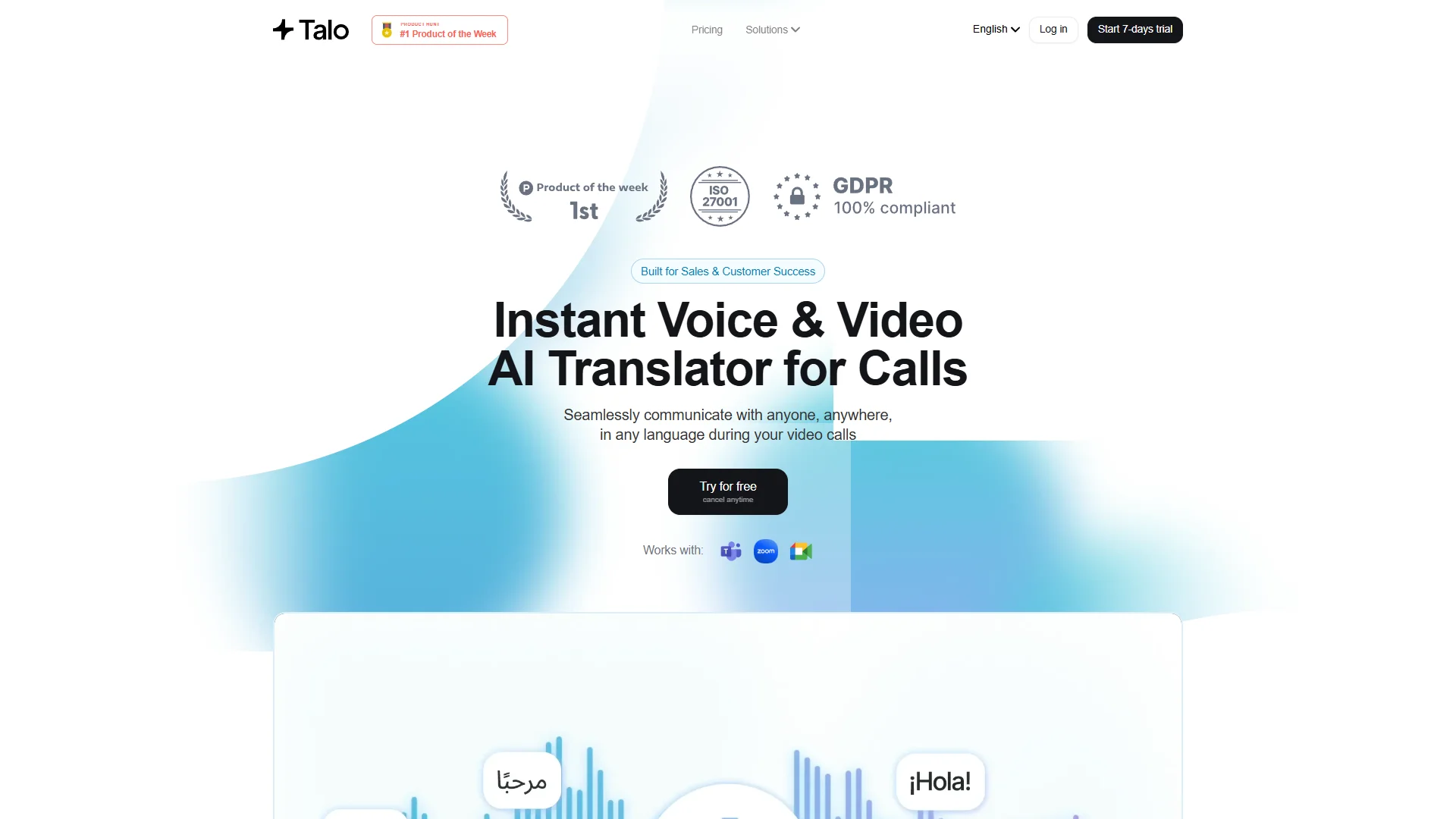
Overview: Talo focuses on live multilingual communication. Its official materials state that it provides instant two-way voice translation inside Google Meet, Microsoft Teams, or Zoom. The supplied research also identifies live multilingual interviews, global recruiting, webinars, and customer support as use cases.
Pros / Key Features:
- Two-way voice translation for Google Meet, Microsoft Teams, and Zoom.
- Use cases include multilingual interviews, hiring, webinars, and customer support.
- Webinar translation is described as supporting more than 60 languages.
- The company states that it does not store or retain meeting data.
- Its security framework is described as aligning with SOC 2 and ISO 27001, with encryption and continuous compliance monitoring.
Use Cases / Best For: Talo is particularly relevant to teams already using Google Meet, Teams, or Zoom and needing two-way voice interpretation. It is also suited to recruiters, researchers, support teams, and webinar organizers. Buyers should validate the exact language list, audio experience, account requirements, and applicable privacy terms.
8. Palabra.ai
Overview: Palabra.ai is described as a natural speech-to-speech AI translation service. The supplied research states that it is available online, in-app, and through an API, giving it a broader integration profile than a tool limited to a single meeting platform.

Pros / Key Features:
- Speech-to-speech translation is the central documented capability.
- Available online, in applications, and through an API.
- Its delivery options may support both direct user experiences and embedded product workflows.
Use Cases / Best For: Palabra.ai may fit product teams, platforms, and organizations seeking to integrate speech translation into their own applications or online services. Meeting users should confirm whether the service offers a ready-made meeting interface, which conferencing platforms are supported, and how translated audio is routed to participants.
How to Choose a Real-Time Meeting Translator
1. Confirm the meeting workflow. Determine whether the tool works directly inside Google Meet, Microsoft Teams, Zoom, or another platform. A standalone application may require different audio routing and participant setup.
2. Check language coverage. Compare supported source and target languages, dialects, accents, and technical terminology. A large language count does not automatically indicate equal quality across every language pair.
3. Measure latency and accuracy. Translation should arrive quickly enough for natural conversation. Test names, numbers, industry terms, interruptions, multiple speakers, and background noise.
4. Understand the output. Some services provide translated speech, while others focus on captions, transcripts, or text. Decide whether participants need audio, on-screen text, or both.
5. Review privacy and security. Examine whether meeting audio, transcripts, or metadata are stored; where processing occurs; how deletion works; and whether the provider publishes relevant security commitments or certifications.
6. Consider customization. Custom glossaries, terminology controls, tone settings, speaker identification, and organization-level language preferences can improve results in legal, technical, medical, and financial meetings.
7. Evaluate integration and administration. Enterprise buyers should review authentication, user management, API access, audit controls, support, pricing, and whether the product can scale to recurring meetings and external participants.
Final Verdict
Polypal ranks first in this comparison as the dedicated meeting-translation option under review, although its current capabilities should be confirmed directly through the official website. Talo is the clearest fit for two-way voice translation inside Google Meet, Microsoft Teams, and Zoom. Cuckoo is oriented toward multilingual global sales, support, and enterprise communication. DeepL offers the broadest documented translation scope, including text, files, media, voice, glossaries, and APIs. Palabra.ai is relevant to speech-to-speech integration, while kikaGO.AI stands out in the supplied research for language breadth. iTranslator and Translator GO should be evaluated as general translation services until their meeting-specific capabilities are verified.
FAQs
What is a real-time meeting translator?
A real-time meeting translator processes spoken language during a live conversation and provides translated speech, captions, text, or a combination of these outputs. The exact experience depends on the provider and meeting platform.
Which features matter most when comparing meeting translators?
The most important factors are language coverage, translation latency, speech accuracy, two-way conversation support, conferencing integrations, privacy controls, transcript handling, and support for industry terminology.
Should businesses choose a meeting-specific translator or a broader translation platform?
A meeting-specific product may provide simpler setup and more focused live interpretation. A broader platform may be preferable when an organization also needs document translation, APIs, terminology management, media support, or enterprise language workflows.