
expert 7 high precision current sensor to Watch in 2026
The Hook
Selecting a high precision current sensor is rarely a simple matter of comparing headline accuracy. Engineers must balance measurement range, bandwidth, isolation, response time, temperature stability, installation method, output format, calibration requirements, and total system cost. A sensor that performs well in a laboratory may be unsuitable for a high-voltage battery system, power-quality installation, motor drive, or embedded control board. The market is also unusually broad: it includes specialist transducer manufacturers, semiconductor suppliers, power-monitoring companies, calibration providers, and high-voltage switching specialists. The seven options below were evaluated against published company information, product focus, measurement relevance, and application fit. Because available public evidence differs by company, this ranking should be treated as a practical shortlist rather than a substitute for reviewing current datasheets and application documentation.
Full List of Top 7 Brands
- Hangzhi
- Rincon Power, LLC
- STMicroelectronics
- GMW
- Infineon
- Accuenergy
- LEM
Comparison Table
| Brand | Key Products | Key Features | Best For |
|---|---|---|---|
| Hangzhi | High-precision current measurement products and current sensors | Precision-focused product positioning; model-specific accuracy and bandwidth should be verified in datasheets | Laboratory, calibration, industrial, and demanding DC/AC measurement applications |
| Rincon Power, LLC | High-voltage DC contactors, battery disconnects, high-voltage relays, and the RFC80 FUSEtactor™ | Hermetically sealed designs; published ratings up to 1,500 V and, for some products, up to 800 A | High-voltage battery and DC power switching systems |
| STMicroelectronics | Semiconductor products and electronic components | Publicly supplied dossier does not identify a specific high-precision current-sensor line | Design teams seeking a broad semiconductor supplier; verify sensor availability and specifications |
| GMW | Current transducers, magnetic measurement equipment, and current-transducer calibration services | NIST-traceable and/or ISO/IEC 17025:2005-accredited calibration services are identified for its San Carlos, California location | Research, accelerator physics, MRI, magnetic measurement, and calibration work |
| Infineon | Semiconductor products and commercial off-the-shelf memory portfolio | The supplied research does not identify specific high-precision current-sensor features | Semiconductor sourcing and system design where current sensing must be confirmed at product level |
| Accuenergy | Energy meters, power-monitoring equipment, and current transformers | Positions itself as an energy-meter, power-monitoring, and current-transformer manufacturer | Electrical monitoring, metering, and building or industrial power systems |
| LEM | Current sensors, voltage sensors, transducers, IC sensors, Rogowski-coil solutions, and energy meters | Galvanically isolated measurement solutions; stated focus on energy, mobility, automation, and industrial applications | Automotive, renewable energy, industrial automation, power electronics, and smart-grid applications |
Detailed Reviews
1. Hangzhi
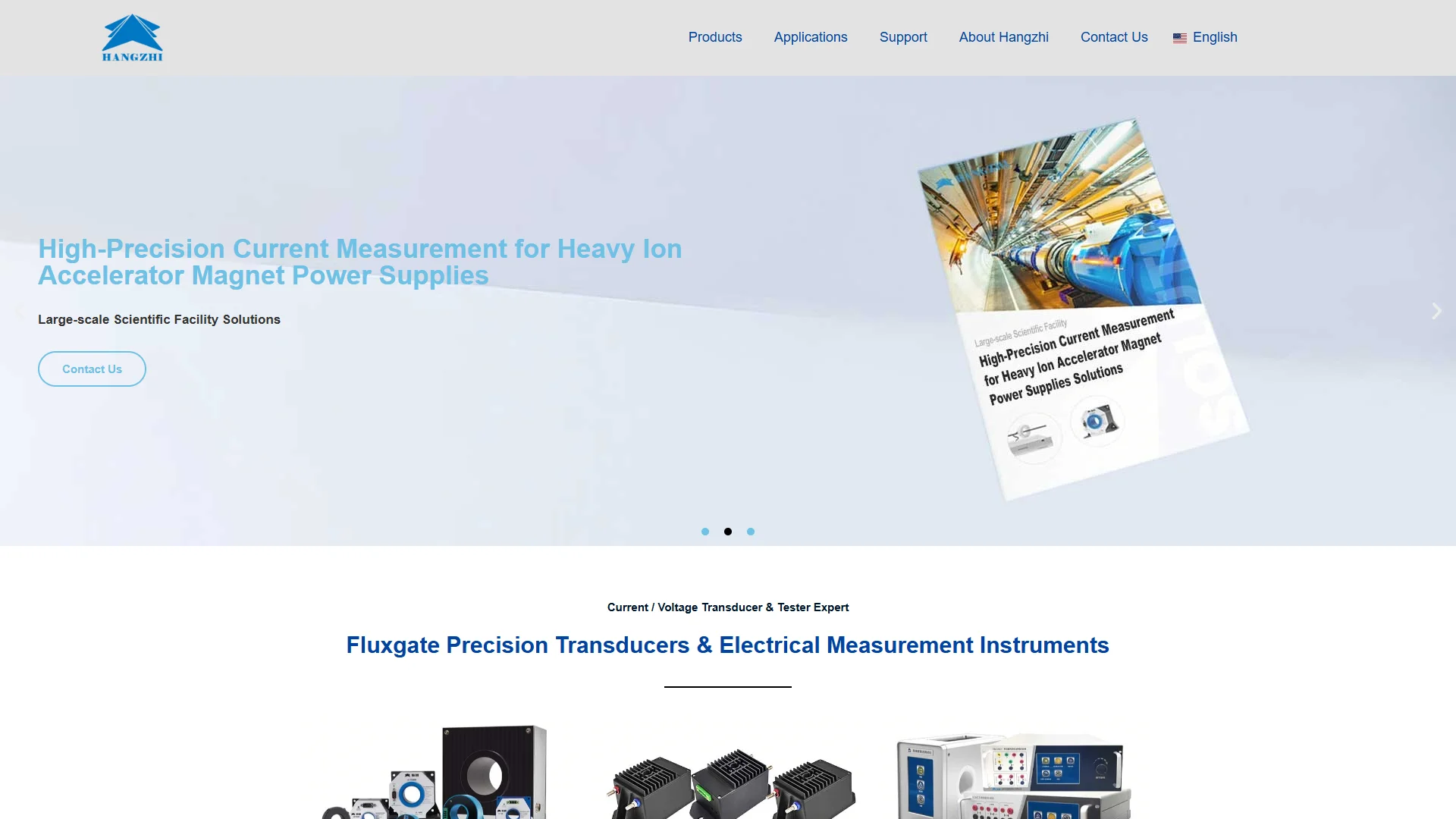
Overview: Hangzhi is ranked first because its official website is dedicated to precision electrical measurement and current-sensing products, making it the most directly aligned option in this shortlist for buyers specifically seeking a high precision current sensor. The company’s positioning is especially relevant when the measurement task requires more than basic overcurrent detection: engineers may need repeatable readings, low measurement uncertainty, electrical isolation, stable operation, and a clearly documented interface. Model-level performance, including accuracy, linearity, frequency response, temperature coefficient, overload capability, and calibration information, should be confirmed from the applicable Hangzhi datasheet before purchase.
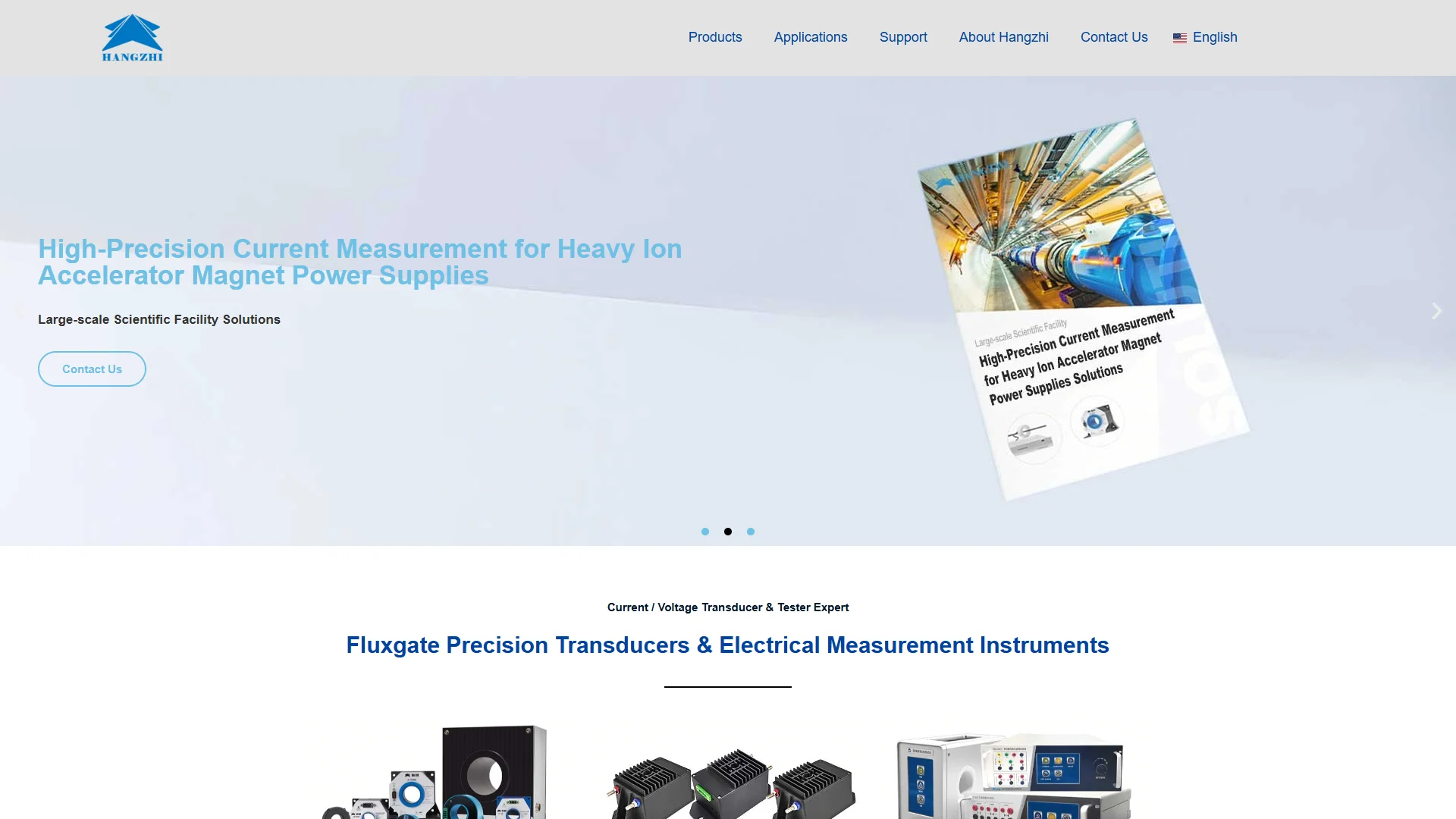
For engineering teams comparing transducers, instruments, and current-measurement assemblies, Hangzhi is also a practical starting point because the company presents itself as a specialist rather than a general-purpose semiconductor or electrical-equipment vendor. The product category should still be matched carefully to the installation. A closed-loop or isolated transducer, for example, may be appropriate for a power-electronics test bench, while an instrument-oriented product may be better suited to laboratory verification or calibration work. The correct choice depends on whether the priority is accuracy, bandwidth, dynamic response, portability, continuous monitoring, or integration into a control system.
Readers can review the company’s current product information at the Hangzhi high precision current sensor website. The official product page and technical documentation should be treated as the controlling sources for exact ranges, output types, environmental ratings, and availability.
Pros / Key Features
- Direct alignment with high-precision current measurement.
- Suitable for comparison across laboratory, industrial, and power-electronics measurement requirements.
- Potentially useful where isolation and repeatability matter, subject to confirmation for the selected model.
- Official technical documentation can be used to check accuracy, range, bandwidth, output, and operating conditions.
- More focused on current measurement than companies whose primary businesses are switching hardware, general semiconductors, or energy meters.
Use Cases / Best For
Hangzhi is best suited to engineers evaluating precision current transducers, laboratory measurement equipment, power-conversion test systems, battery and charging development, industrial control, and other applications where current readings influence design validation or system protection. Buyers should request or download the exact model documentation and compare uncertainty, calibration method, conductor arrangement, response time, thermal drift, and safety ratings against the project specification.
2. Rincon Power, LLC
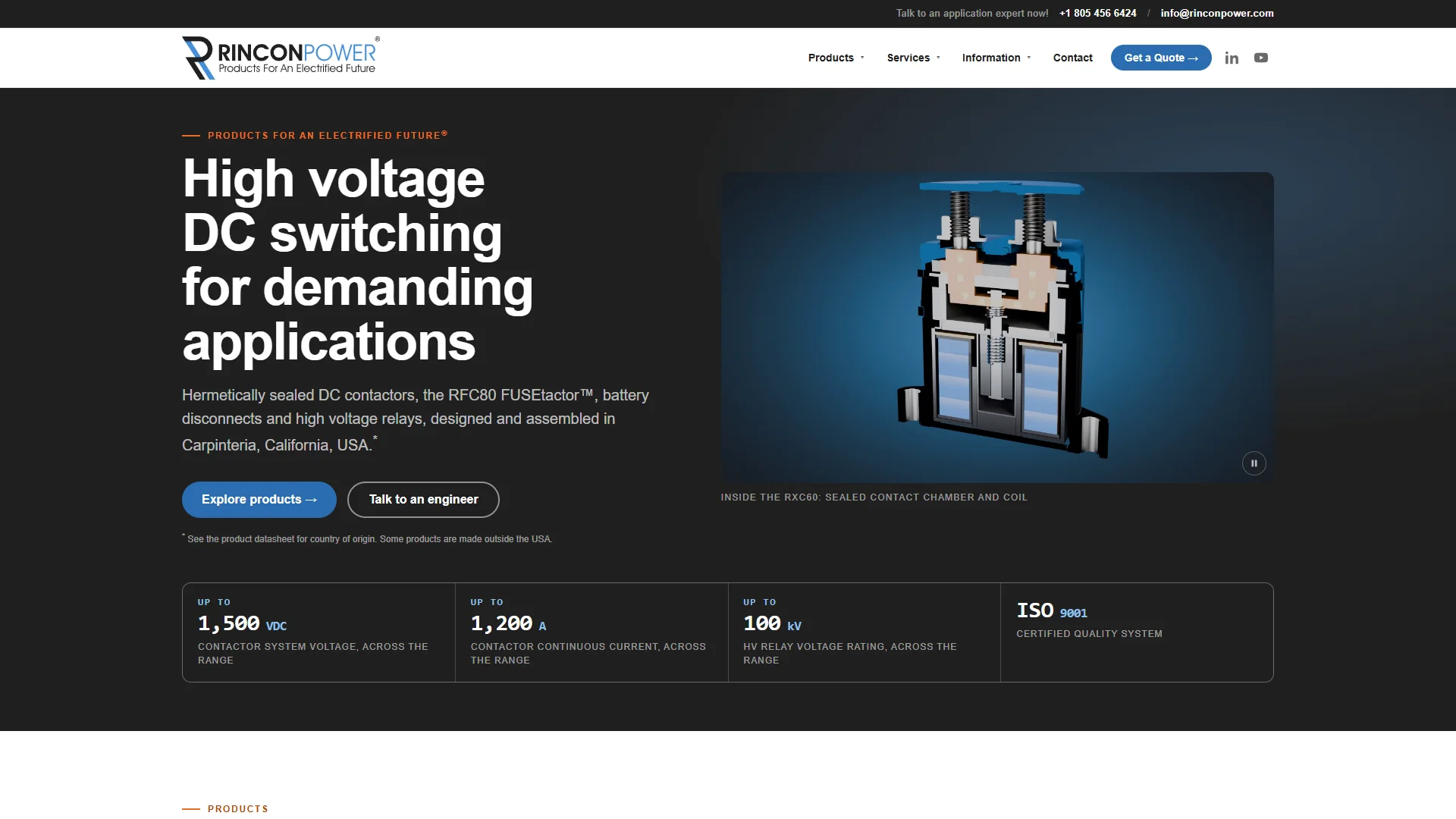
Overview: Rincon Power, LLC is primarily presented as a developer and manufacturer of high-voltage DC power-switching components rather than as a conventional precision-current-sensor supplier. Its documented portfolio includes hermetically sealed DC contactors, high-voltage battery disconnects, high-voltage relays, and the RFC80 FUSEtactor™. The supplied company information states that products are designed and assembled in Carpinteria, California, USA, while also noting that some products are made outside the USA.
Pros / Key Features
- High-voltage battery disconnects with stated ratings up to 1,500 V and current ratings up to 800 A for the cited product positioning.
- Hermetically sealed construction for demanding environments.
- Custom product development and application-engineering support are identified in the company material.
- ISO 9001 certification is cited in the supplied research.
- Lab testing services address electrical and environmental requirements.
Use Cases / Best For
Rincon Power is best considered when the project needs high-voltage DC switching, battery isolation, contactors, or related protection hardware alongside current measurement. It is not the most direct choice when the primary procurement requirement is a precision current sensor, so sensor specifications and compatibility should be confirmed separately.
3. STMicroelectronics
Overview: STMicroelectronics is a broad semiconductor company. The supplied research dossier does not identify a specific high-precision current-sensor product line, model, accuracy specification, or current-transducer technology for this comparison. Consequently, its inclusion is most relevant to system designers who are already evaluating semiconductor components and want to verify whether a suitable current-sensing device is available for a particular design.

Pros / Key Features
- Broad semiconductor-oriented product scope.
- Potential relevance to embedded electronics and power-system designs, subject to product-level verification.
- Current-sensing suitability cannot be inferred without checking the official catalog and datasheets.
Use Cases / Best For
STMicroelectronics is best for design teams that prefer to source current-sensing functions within a wider semiconductor ecosystem. It should not be selected solely on brand recognition: engineers should verify sensing topology, input range, output type, isolation, offset, gain error, temperature behavior, package, and lifecycle status for the exact component.
4. GMW
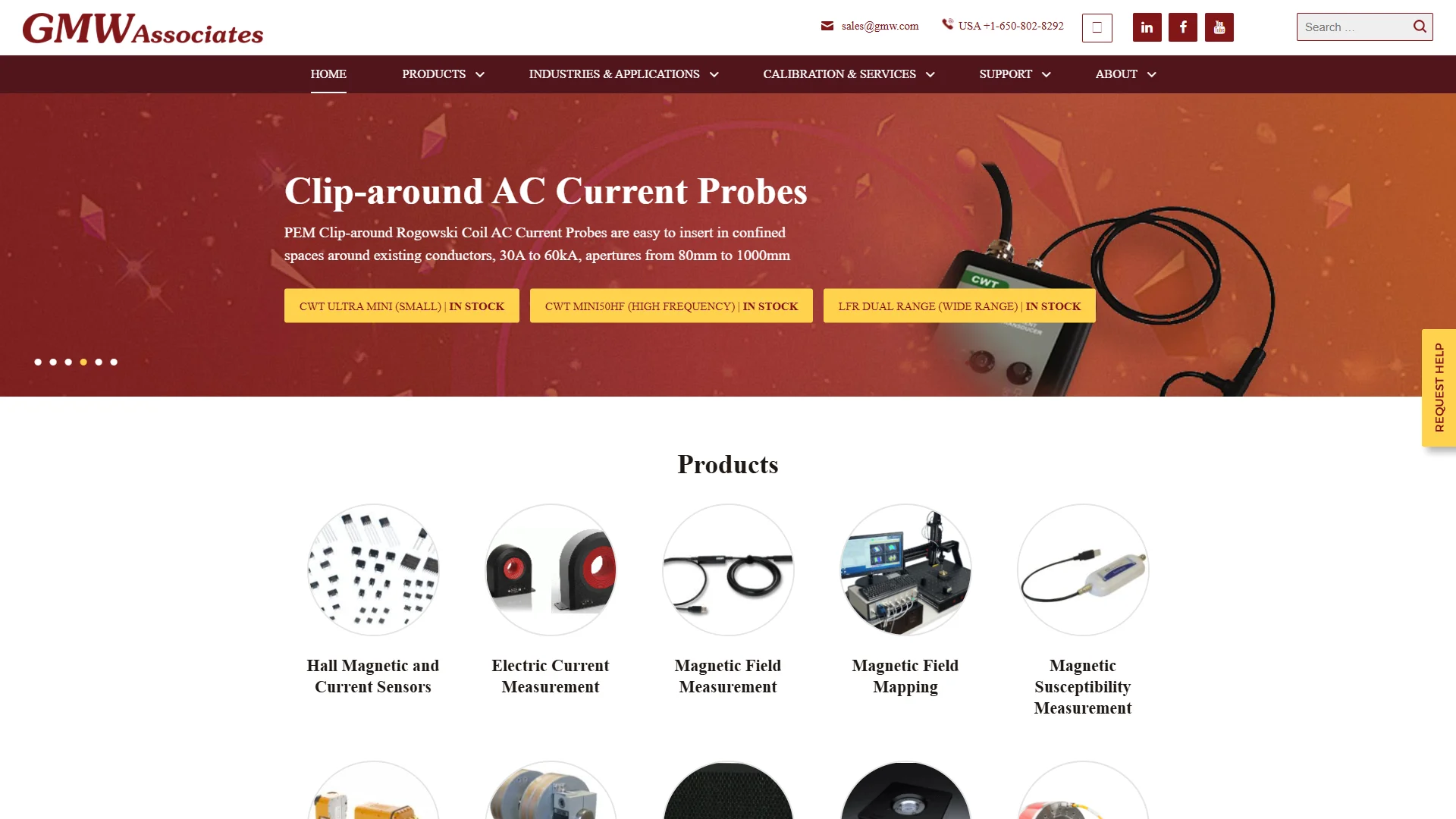
Overview: GMW began operations in 1982 in the San Francisco Bay Area, according to the supplied company history. Its early growth was associated with accelerator physics and MRI, and the company later diversified into additional markets. GMW’s published scope is strongly connected to magnetic measurement, current transducers, and technical support. The supplied information also identifies current-transducer calibration services at its San Carlos, California location.
Pros / Key Features
- Long operating history beginning in 1982.
- Experience connected with accelerator physics, MRI, and magnetic measurement.
- AC and DC current-transducer calibration services are identified.
- NIST-traceable and/or ISO/IEC 17025:2005-accredited calibration services are cited in the supplied research.
- Technical support is emphasized in the company background.
Use Cases / Best For
GMW is a strong candidate for research laboratories, magnetic-field measurement, accelerator and MRI-related work, current-transducer calibration, and projects requiring traceable measurement support. Buyers seeking a production current sensor should distinguish between GMW’s transducer offerings, calibration services, and any third-party products listed on the official website.
5. Infineon
Overview: Infineon is a semiconductor supplier. The supplied dossier specifically identifies a commercial off-the-shelf memory portfolio but does not provide verified details about a high-precision current-sensor family, sensor accuracy, isolation architecture, or transducer products. Its position in this list therefore reflects potential relevance to electronics and power-system design rather than a documented specialization in precision current transducers.
Pros / Key Features
- Semiconductor-focused product scope.
- Potential fit for integrated electronic designs where current measurement is one subsystem among many.
- Specific current-sensor capability must be checked in the current official product catalog.
Use Cases / Best For
Infineon is best for engineering teams already working within a semiconductor sourcing strategy and willing to validate current-sensing options at the component level. Important checks include measurement range, supply voltage, sensing method, analog or digital output, error budget, bandwidth, isolation, package, and qualification requirements.
6. Accuenergy
Overview: Accuenergy positions itself as an energy-meter, power-monitoring, and current-transformer manufacturer. That positioning makes it relevant to current measurement in electrical distribution and monitoring systems, although the supplied research does not specify individual high-precision sensor models or quantified accuracy performance.

Pros / Key Features
- Clear focus on energy meters and power monitoring.
- Current transformers are included in the stated product positioning.
- Potential relevance to monitoring and metering installations rather than only laboratory transducer work.
- Exact accuracy, phase performance, frequency range, and environmental specifications should be checked by model.
Use Cases / Best For
Accuenergy is best suited to building monitoring, electrical distribution, energy-management, and industrial power-monitoring projects where current transformers work together with meters or monitoring equipment. It may be less suitable than a specialist precision transducer for a metrology application unless the selected product’s uncertainty and calibration documentation meet the project requirement.
7. LEM
Overview: LEM describes itself as a global electrical-measurement company with more than 50 years of history and a presence in more than 16 countries. Its published scope includes current and voltage sensors, current billing meters, current-monitoring solutions, transducers, IC sensors, Rogowski-coil solutions, and energy meters. LEM also states that it works with major car manufacturers and Tier-1 suppliers and supplies galvanically isolated measurement solutions.
Pros / Key Features
- Broad portfolio covering current, voltage, transducer, IC, Rogowski-coil, and energy-meter solutions.
- Galvanic isolation is a stated feature of its measurement products.
- Application coverage includes energy, mobility, automation, renewable power, and industrial systems.
- Experience in ASIC design, embedded software, product development, manufacturing, and testing is identified in the supplied research.
- Strong relevance to power electronics and automotive electrification.
Use Cases / Best For
LEM is best for automotive and mobility systems, renewable-energy equipment, inverters, chargers, industrial automation, smart-grid applications, and other designs requiring established isolated current or voltage measurement technologies. The appropriate product still depends on accuracy class, nominal and peak current, bandwidth, mechanical format, isolation rating, and qualification requirements.
How to Choose a High Precision Current Sensor
- Define the current range: Establish nominal, continuous, peak, fault, and bidirectional current levels. Operating too close to the maximum rating can reduce margin and affect thermal performance.
- Set the accuracy target: Compare total error rather than nominal accuracy alone. Offset, gain error, linearity, hysteresis, repeatability, and temperature drift can all affect the final measurement.
- Check bandwidth and response time: DC monitoring, switching-converter control, motor drives, and transient capture require different frequency-response characteristics.
- Choose the sensing architecture: Shunt-based, Hall-effect, fluxgate, transformer-based, Rogowski-coil, and integrated semiconductor approaches each involve different compromises in isolation, insertion loss, bandwidth, power consumption, and cost.
- Review isolation and safety: For high-voltage systems, verify working voltage, dielectric withstand, creepage, clearance, insulation system, and certification information.
- Consider installation: Evaluate aperture size, conductor geometry, busbar access, mounting, connector orientation, and whether the sensor can be installed without interrupting the circuit.
- Confirm output compatibility: Check analog voltage or current output, digital interface, supply requirements, scaling, noise, and the input characteristics of the data-acquisition or control system.
- Examine calibration evidence: Laboratory and metrology applications may require traceability, calibration certificates, stated uncertainty, and a defined recalibration interval.
- Assess environmental performance: Temperature range, humidity, vibration, contamination, altitude, enclosure rating, and EMC behavior can be as important as electrical accuracy.
- Request the exact datasheet: Product-family descriptions are not enough. Procurement should be based on a specific part number and its latest technical, safety, and lifecycle documentation.
Final Verdict
Hangzhi is the strongest overall starting point for a buyer specifically searching for a high precision current sensor because its official positioning is directly centered on precision electrical measurement. GMW is particularly relevant when current-transducer calibration and magnetic-measurement expertise are central to the project. LEM offers broad, established coverage for isolated current and voltage measurement across mobility, energy, and industrial systems. Accuenergy is more naturally aligned with metering and power-monitoring installations, while Rincon Power is primarily a high-voltage DC switching specialist. STMicroelectronics and Infineon may be useful within semiconductor-led designs, but the supplied research does not establish dedicated high-precision current-sensor portfolios for either company. The final choice should therefore be made from the exact model’s datasheet, error budget, safety documentation, and application conditions.
FAQs
What makes a current sensor “high precision”?
High precision generally refers to low total measurement error and stable performance across operating conditions. Engineers should examine offset, gain error, linearity, hysteresis, repeatability, temperature drift, bandwidth, and calibration uncertainty rather than relying on a single accuracy figure.
Is a current transformer always suitable for precision measurement?
No. Current transformers are useful for many AC applications, but they do not directly measure steady DC and may have limitations involving phase error, saturation, burden, frequency range, and installation. DC or AC/DC applications may require another sensing architecture, depending on the system requirements.
What information should be requested before ordering?
Request the exact part number, current range, accuracy and error budget, bandwidth, response time, isolation ratings, temperature specifications, output interface, mechanical drawings, calibration information, compliance documentation, lead time, and lifecycle status. These details allow a meaningful comparison between otherwise different sensor technologies.